

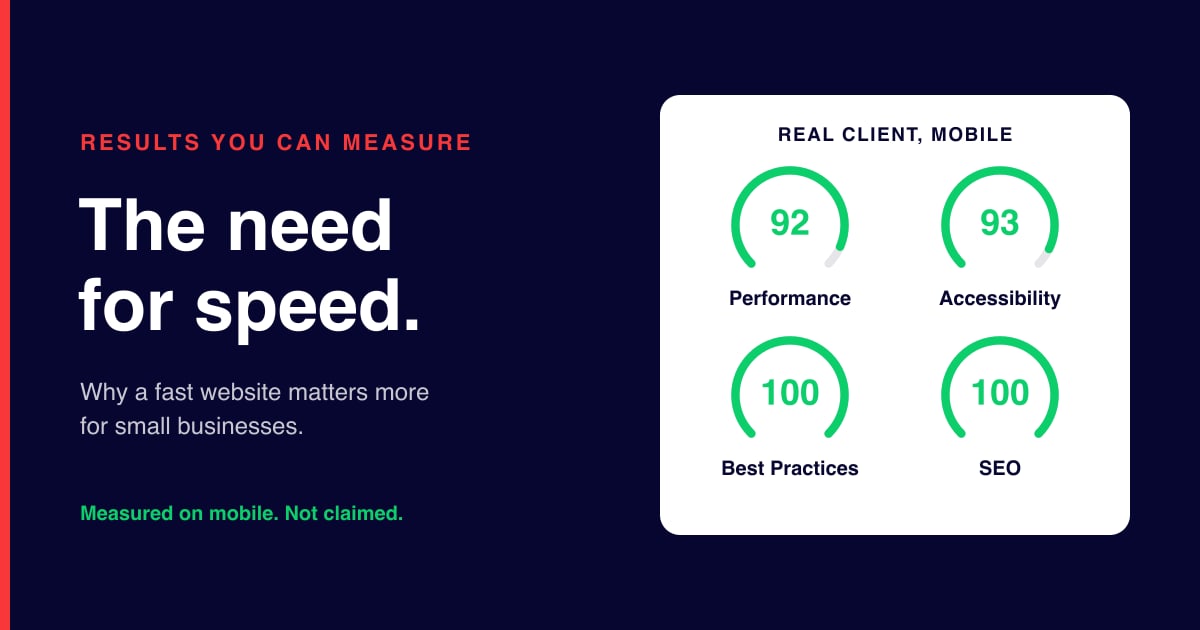
Most small businesses lose visitors before a single word is read. Not because the offer is wrong or the design is poor, but because the page is slow. On a phone, on real mobile data, a slow site is an empty shop with the lights off.
The good news is that speed is one of the few things a small business can fix without a big budget. It does not need a famous brand or a marketing department. It needs the right build, the right host, and a handful of disciplined decisions.
Why speed matters more when you are small
A large brand can survive a slow site. People already know the name, so they wait. A small business has no such credit. The visitor has never heard of you, is on their phone, has three other tabs open, and will judge you in the first couple of seconds.
Speed affects the things that actually drive enquiries:
- Trust. A site that loads instantly feels professional and looked after. A site that hesitates feels risky before anyone has read a word.
- Bounce. Every extra second of load time increases the share of people who leave without doing anything.
- Search. Page speed and stability are part of how Google ranks pages. A faster site is easier to find as well as easier to use.
- Conversion. Fast, stable forms and pages remove friction at the exact moment someone is deciding whether to contact you.
None of this requires the visitor to consciously notice the speed. They simply feel that one site is solid and another is not.
Proof: a two-stylist salon that loads like a big brand
We say speed is a budget-independent advantage, so here is the evidence rather than the claim.
H&Co Hairdressing is a two-stylist salon in Guiseley. Not a chain, not a national brand, exactly the kind of local business that usually gets a slow templated site. We built it on a fast static stack and served it from a global edge network. The result, measured on a throttled mobile connection by Google PageSpeed Insights, is 92 Performance, 93 Accessibility, 100 Best Practices and 100 SEO, with desktop scores higher again.
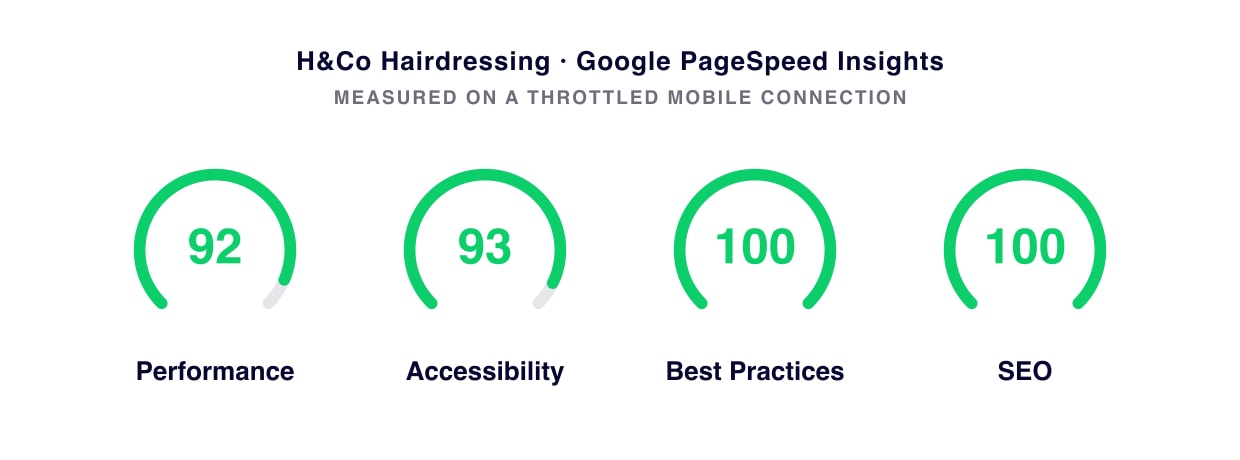
That is a photo-led, content-rich site for a local business outperforming the websites of companies many times its size. The deciding factor was not money. It was how the site was built and where it is hosted. Our F8 Group project tells the same story for a far more technical proposition.
The recipe: how to make your site faster
You can move most sites a long way with the steps below. Some you can do yourself, others are better handed to a developer, but all of them are within reach of a small business.
1. Fix your images first
Images are almost always the single biggest cause of a slow site. The common mistakes are uploading a 4000-pixel photo to display it at 600 pixels, using old formats, and serving the same heavy image to a phone as to a desktop.
- Export to a modern format such as WebP.
- Resize images to the size they actually display at.
- Serve smaller versions to smaller screens.
- Set a width and height on every image so the page does not jump around as it loads.
This one area often accounts for the majority of the gain.
2. Stop carrying dead weight in video
Autoplay background video is the second worst offender. An uncompressed clip can be larger than the rest of the page combined. If you use video, compress it hard, strip the audio track from a muted background loop, and never let a large raw file load on a phone. Better still, use a streaming service that adapts the quality to the connection.
3. Self-host and limit your fonts
Every font file is a download that blocks text from appearing. Pulling fonts from a third party adds an extra connection on top. Self-host your fonts, and use two weights, not nine.
4. Cut the third-party scripts
Chat widgets, trackers, pop-up tools, review embeds and page-builder bloat each add weight and slow the page down. Keep what genuinely earns its place and remove the rest. Every script you add is a tax on every visitor.
5. Choose a platform and host built for speed
This is the decision that sets the ceiling for everything else. A heavy page builder on cheap shared hosting will always struggle, no matter how much you optimise. A modern static build served from an edge network is fast by default. The platform and the host are not technical trivia. They are the foundation.
6. Measure like a real visitor
Test on a real phone, on mobile data, not on your office wifi on a laptop. Run Google PageSpeed Insights and read the mobile score, not the desktop one. The mobile number is the one your customers actually experience.
When to get help
Some of the recipe is genuinely a do-it-yourself job. Some of it is not, and there is no shame in that. There are three points where it usually makes sense to bring us in:
- A speed and optimisation pass. Your site is fundamentally sound but slow. We measure it, fix the images, scripts and load order, and lift the scores without rebuilding anything. The fastest route to a quick improvement.
- Better hosting. Your site is held back by the platform or the host underneath it. Our hosting and maintenance work moves you onto something fast and keeps it that way after launch.
- A rebuild. The platform itself is the problem and optimisation can only do so much. A focused web development rebuild on a fast modern stack is the option that produces results like the salon above.
Related services
- Web Development for fast, stable sites built right from the start
- Hosting & Maintenance for speed and care that lasts after launch
- Case Studies for the measured proof behind the claims
FAQs
How fast should my website be?
Aim for a useful page on a mobile connection in under two and a half seconds, and a PageSpeed mobile score in the 90s. The salon example shows that is achievable on a small budget when the build is right.
Is speed really worth paying for?
Yes, because it compounds. Speed improves trust, search ranking and conversion at the same time, on every visit, indefinitely. Few marketing spends keep paying back the way a faster site does.
Can I just optimise, or do I need a rebuild?
Often optimisation alone is enough, and it is always the first thing we check. A rebuild is the right answer only when the platform or host underneath sets a ceiling that no amount of tuning can lift.
Does speed actually help with Google?
Yes. Page speed and visual stability are part of how Google assesses pages. A faster, steadier site is easier to find as well as easier to use, so the benefit is both human and algorithmic.
Want to know how fast your site really is?
If your website feels slow, or you simply do not know how it performs on a phone, book a call. We will measure it properly and tell you honestly whether it needs a tune-up, better hosting, or a rebuild.